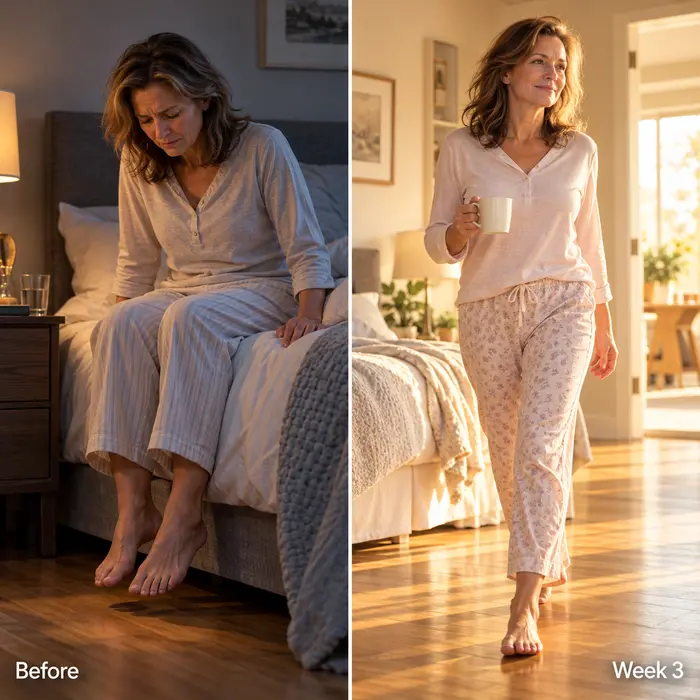
Before: dreading the first step. Week 3: your feet never crossed your mind.


The Boot You Ripped Off at 2 AM Was the Boot's Problem — Not Yours
The support was underneath your foot — trapping heat, crushing toes, waking you up. Move it to the top, and you sleep through the night. That's the whole fix.
Already read the article? Skip to your 60-Night Morning Walk Trial offer →
New to DorsalFlex? Here's the 30-second version +
While you sleep, the tissue under your foot pulls tight. When you stand up, your weight rips it open.
That's the stab. A night splint stops it — but only if you can sleep in one. Most people can't make it past 2 AM.
One design decision changes that — and changes what you feel when you stand up tomorrow.
Every morning, your full bodyweight lands on tissue that contracted overnight. That's the stabbing pain in your heel.
A night splint holds your foot in a gentle stretch while you sleep so the tissue stays loose.
The problem: most night splints are rigid boots. They trap heat, squeeze your toes, and you rip them off at 2 AM.
The DorsalFlex sits on top of your foot — open heel, free toes, nothing underneath.
That's the design difference that lets people wear it all night.
The 2023 APTA Clinical Practice Guideline recommends 1–3 months of consistent nightly use for people with first-step morning pain.
- Step out of bed and walk — no hobbling, no waiting, no gripping the nightstand
- Sleep through the night in any position — open heel, free toes, nothing digging into the mattress
- Keep it on all night — gentle dorsal hold, not a rigid boot you rip off at 2 AM
- Backed by 2023 APTA guidelines — consistent nightly use for 1–3 months for first-step morning pain
"This one sits on top of your foot, not underneath. I wear it all night."
— Sarah P., 56 · Verified Buyer
Here's everything in your Morning Walk Trial:
✓ DorsalFlex Morning Relief Splint
✓ 2-Week Break-In Guide (included free)
✓ Bedside First-Steps Morning Routine Card (included free)
✓ Free shipping both ways
✓ 60-Night Morning Walk Guarantee
PT clinic price: $80–$120. Direct-to-you price: $59
No retail shelf, no clinic overhead — we ship direct. That's why yours starts at $59, as long as we keep shipping direct.
Less than $1 a night. Less than a single podiatrist copay.
And if your mornings don't change in 60 nights, send it back free.
Comfort Set adds: silicone toe separators + fascia massage roller + 2-week recovery guide. Most people feel arch cramping in the first week as the fascia loosens — the toe separators and roller handle that so you sleep through it.
✓ In Stock — Order by 2 PM EST for next-business-day shipping
We produce in small batches. Current batch is shipping now — when it sells through, the next run is 2–3 weeks out.
Our last two runs sold through in under three weeks each.
"I waited a week and it went on backorder for 3 more. Don't make my mistake." — Janet W.
Every morning you wait is another morning you start on the edge of the bed, bracing yourself.
Wake Up Without the Hobble →Free shipping both ways · 60-Night Morning Walk Guarantee · No subscription
Click below → pick your size → secure checkout → we ship tomorrow in a plain box → try it for 60 nights risk-free.
I've tried night splints before. They didn't work. Why would this be different?
If your last splint ended up in the closet, it didn't fail because the concept is wrong.
It failed because you couldn't sleep in it long enough to get results.
The 2023 APTA guidelines say night splints should be worn 1–3 months. That only works if the splint stays on.
Most boots make that impossible.
The rigid shell digs into the mattress, the plastic traps heat, and by 2 AM you've ripped it off.

The DorsalFlex is a dorsal splint. The support sits on top of your foot, not underneath.
Open heel, open toes. It lies flush on the bed in any sleep position.
Most people keep it on all night by night 4 or 5.
Can I sleep in this?
Yes. The DorsalFlex sits on top of your foot — open heel, open toes, nothing trapping heat.
The break-in schedule starts you at 2 hours and builds to a full night by day 7–10.
I'm a side sleeper. Will this work?
Side sleepers are the #1 reason people quit posterior boots. The rigid shell digs into the mattress.
The DorsalFlex lies flush against the bed in any position.
What if it doesn't work for me?
60-Night Morning Walk Guarantee.
If your first 10 steps aren't easier — for any reason — email us for a full refund.
No forms, no restocking fees, we cover return shipping.
Why does this cost more than the $20 splints on Amazon?
Those $20 splints use injection-molded plastic — cheap to make, rigid to wear, abandoned by 2 AM.
The DorsalFlex uses a padded dorsal shell with adjustable, covered straps.
Built for people who've already tried the cheap ones and quit.
One splint you wear all night costs less than three you didn't.
How do I know it will fit?
The DorsalFlex fits shoe sizes 5 to 13.
The adjustable straps let you set how firm the hold feels on your foot.
If the fit isn't right for any reason, exchange it free under the 60-Night Morning Walk Guarantee.
They Spent Hundreds Before They Found What Actually Lasts

"Third night splint. First one I haven't ripped off at 2 AM."
I bought two boots on Amazon before this — one was so hot I couldn't last an hour, the other gave me numb toes by midnight.
This one stays on because it doesn't trap your foot in a plastic shell.
The open-heel design is the difference.
Took about a week to get used to wearing it all night, but the break-in guide made that easy.

"It is very nice to wake up and walk with no pain."
I'd been dealing with morning heel pain for over a year.
Tried insoles, frozen water bottles, every stretch on YouTube.
This was the first thing that made a real difference in how my feet felt when they hit the floor.
Took about 10 days to feel it.

"I've spent over $400 on things that didn't work. This was $59."
Custom orthotics, cortisone shots, three different insoles, a boot I wore twice.
None of it touched the morning pain.
This is the first thing that changed how my feet feel when they hit the floor.
I walk a 12-mile route every day — I can't afford mornings that start with a 10-minute hobble.
Individual results may vary. Reviews reflect the personal experience of verified buyers.
Ever lie in bed dreading that first step?
Here's why it works — in plain terms:
Already read the full breakdown? Skip to "Does This Sound Like Your Morning?" →
The night splint works. The boot doesn't let you sleep in it.
Every night, your foot drops into a pointed position. The tissue along your sole pulls tight for hours.
By morning, it's locked short — and your full weight rips it open the second you stand.
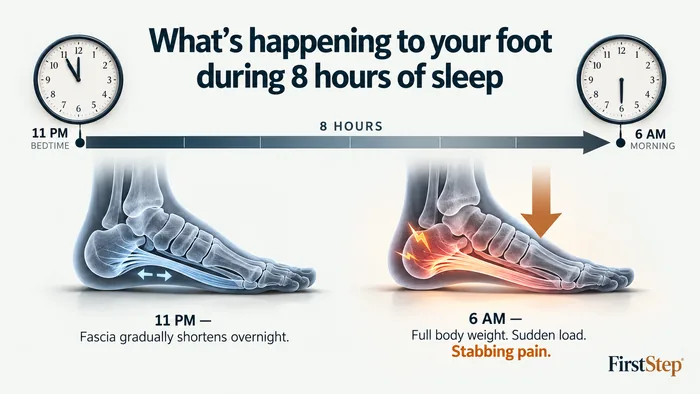
A night splint holds your foot in a gentle stretch so the tissue stays long while you sleep.
The science isn't the problem.
The boot is. Rigid, hot, built like a ski boot.
Most people rip it off by 2 AM — and a splint in your closet by sunrise isn't doing anything.
The DorsalFlex moves the support to a slim bar on top of your foot. Open heel.
Free toes. Nothing pressing on your sole.
That's why people wear this one all night — and why they say the morning stab lost its edge.
If you've tried a night splint before and couldn't sleep in it — that wasn't willpower.
It was design. That's the gap this splint was built to close.
"I'd already bought three splints off Amazon. Every one ended up in the closet. This one's been on my foot for 11 weeks." — Linda M., 61, Verified Buyer
Does This Sound Like Your Morning?
The Morning Hobbler
Your worst pain is your first 10 steps.
You sit on the edge of the bed, bracing yourself, because you already know what's coming when your feet hit the floor.
You don't want a product. You want to stand up and walk — the way you used to.
The Boot Quitter
You've tried a night splint before — rigid, hot, ripped off by midnight.
You didn't fail it. It failed you. You're not looking for another gadget.
You're looking for the one you don't take off.
The Closet Full of Insoles
Orthotics, gel inserts, compression socks, stretching routines.
You've tried them all. And your closet is the proof.
None of them touch what happens while you sleep.
The slow tightening that resets your pain every single morning.
The On-Her-Feet Worker
Nurse, teacher, retail — you need mornings that start clean.
Not ten minutes of stretching before you can walk to the kitchen.
Not limping into your shift hoping no one notices.
Just feet that work when the alarm goes off.
If any of that sounds familiar, the next question is obvious.
What makes this splint different from the ones already in your closet?
Those results didn't happen by accident.
They happened because of one design decision that changes everything about how a night splint works.
Why the Splint in Your Closet Didn't Work
Most of our customers already owned a night splint before they found us.
Here's what they told us about each one — and why they stopped wearing it.
Rigid posterior boot — rigid shell underneath the foot and behind the calf.
Over 7,000 reviews, but read the 1-stars: "too bulky to sleep in," "slides down," "ripped it off at midnight."
The #1 complaint: too heavy and hot to wear all night.
Another posterior boot with Velcro straps. Affordable, but the straps wear out within weeks.
At 3.6 stars, the reviews are blunt: "Velcro stopped holding," "slips while you sleep," "gave me numb toes."
The #1 complaint: straps fail fast and the fit degrades.
A sock-style alternative — a strap from the toe to below the knee. Lighter than a boot, but the pull comes from the big toe.
Customers say: "toe goes numb," "slides down to ankle," "woke up with it bunched around my calf."
The #1 complaint: toe pressure and constant slipping.
The pattern is the same every time.
The splint works for a few hours — then you take it off. By morning, it's on the floor or the nightstand.
The tissue tightened all night. The stab is waiting.
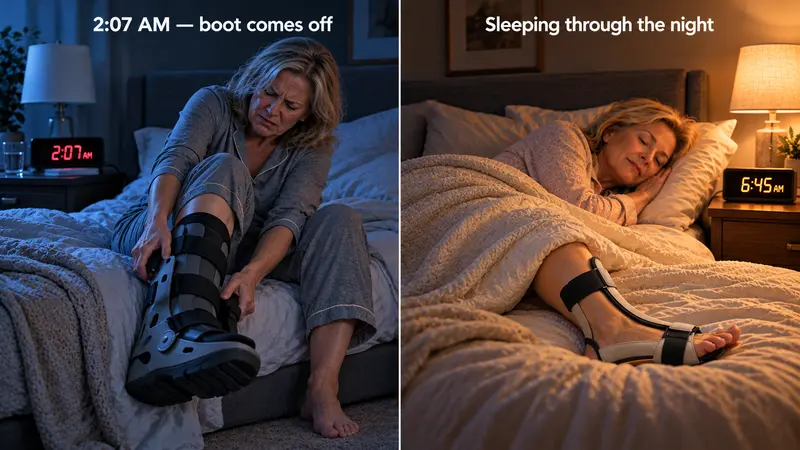
Where They Put the Support Changes Everything
Boots and socks fail because of where they put the brace.
Underneath the foot (hot, heavy) or on the toe (numbness, slipping). The DorsalFlex puts it on top.
A slim bar along the top of the foot holds the stretch. Nothing underneath. Nothing on the toes.
|
Posterior Boots United Ortho, BraceAbility, etc. |
Strassburg Sock | DorsalFlex | |
|---|---|---|---|
| Stretch source | Rigid shell under foot | Strap pulling big toe | Bar along top of foot |
| Weight | 1.5–2+ lbs | Light (sock) | Under 8 oz |
| Heel | Enclosed — traps heat | Covered (sock) | Open — breathable |
| Toes | Enclosed or compressed | Constant toe pull | Open — zero pressure |
| Side sleeping | Shell digs into mattress | Strap slides off | Lies flush in any position |
| Stays on? | Often off by 2 AM | Slides to ankle | Padded straps hold all night |
| All-night wear | Rare | Inconsistent | Designed for it |
A night splint only helps if you wear it all night. Boots are too heavy. Socks slip.
The DorsalFlex keeps the stretch and fixes the design.
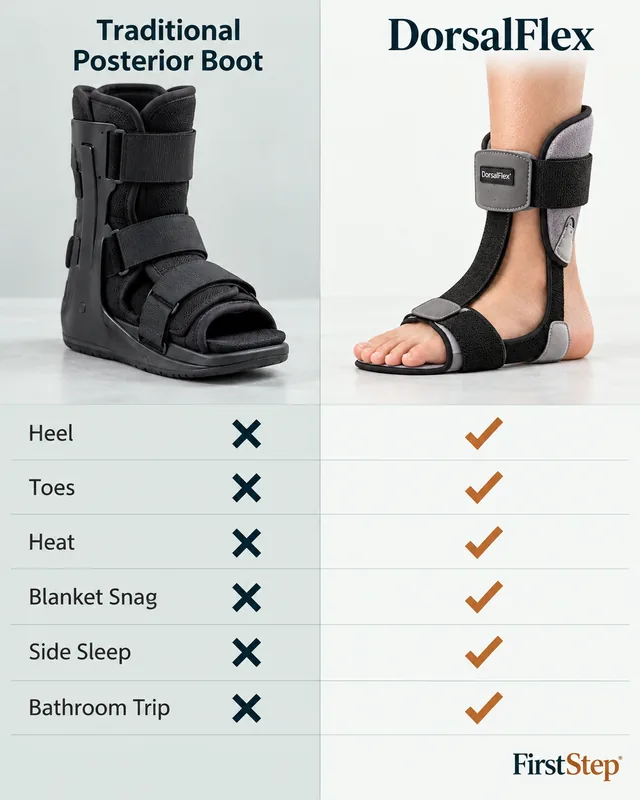
The design is the difference. And the guarantee means you don't have to take our word for it.
Start My 60-Night Trial →Free shipping both ways · 60-Night Morning Walk Guarantee · Fits sizes 5–13
How many mornings have you started on the edge of the bed, bracing yourself?
Why a Podiatrist Stopped Recommending Boots

Dr. Lauren Hayes, DPM, Doctor of Podiatric Medicine · Board-Certified Foot & Ankle Specialist
"I stopped recommending traditional night boots years ago."
If you read the article, you already know why — and you already know what happened when Linda tried her third splint.
Dr. Hayes saw the same pattern in hundreds of patients.
The research was promising — overnight splinting showed results in clinical trials.
The APTA guideline recommends it for 1 to 3 months. But her real-world patients weren't getting results.
"9 out of 10 told me the same thing: they ripped the boot off by 2 AM.
"The rigid shell trapped heat. Compressed their toes. Dug into the mattress when they rolled over.
"The splint was doing its job. Holding their foot in neutral position.
"But nobody could tolerate wearing it long enough."
She investigated why clinical trials showed results while her patients didn't.
The answer was simple: wear time . Trials measured patients who wore the splint. Her patients couldn't.
"When I saw the dorsal design, it clicked. The support bar sits on top of the foot. No hard plastic shell underneath.
"Open heel. Open toes. Nothing compressing the sole. That's why people could finally wear it all night.
"And that's why they were getting the morning relief the research promised."
Picture tomorrow morning. Your alarm goes off. You swing your legs over the side of the bed.
Both feet hit the floor — and nothing. No stab. No wince. No gripping the nightstand.
You stand up and walk to the kitchen.
The DorsalFlex is how you get there without losing sleep to get it.
"Night splints are recommended for a duration of 1 to 3 months as part of a comprehensive management approach for plantar heel pain, particularly when morning pain is the primary complaint."
— 2023 APTA Clinical Practice Guideline for Heel Pain (JOSPT)
"This is my third night splint. First one I've actually kept wearing."
"I wasted about $70 on two cheap Amazon ones that both ended up in the closet.
"One slipped off, the other gave me numb toes by midnight.
"This one stays on, the Velcro feels durable, and the break-in schedule they include made the first week bearable.
"Should have started here."
— Diane R., 54 · Nurse · Jacksonville, FL · Verified purchaser
That's the clinical side. But you're not buying a mechanism — you're buying easier mornings.
So what does using it actually look like?
Two Minutes Before Bed. That's the Whole Routine.

1. Slide On
30 seconds. Snug the straps until you feel a gentle hold.

2. Sleep & Walk
Get up, walk to the bathroom, walk back. It stays on.

3. Morning Test
Take it off. Stand up. See how your first 10 steps feel.
30 seconds before bed: slide it on. Snug the straps until you feel a gentle hold — not a stretch.
Your heel sits in open air. Your toes are free. Pull the covers up — you won't feel it under the blanket.
Middle of the night: get up, walk to the bathroom, walk back.
It stays on. Most people stop noticing it by night three.
Morning: take it off. Swing your legs over. Stand up. And see how your first 10 steps feel compared to yesterday.
The break-in schedule in the box walks you through the first two weeks, night by night.
By day 7–10, most people wear it through the full night without noticing.
Why This One Doesn't End Up in Your Closet
Cheap splints slip, overheat, and fall apart.
The DorsalFlex was built to survive months of nightly wear — and feel the same on night 90 as night 1.


Every detail exists to solve one problem. Keeping the splint on your foot all night, every night, for months.
So what does that actually look like, night by night?
Week 1 Feels Strange. Week 4 Feels Different. Week 12 — You Stop Counting.
The DorsalFlex is not a quick fix — and that's exactly why it works. It builds every night. Here's what to expect.
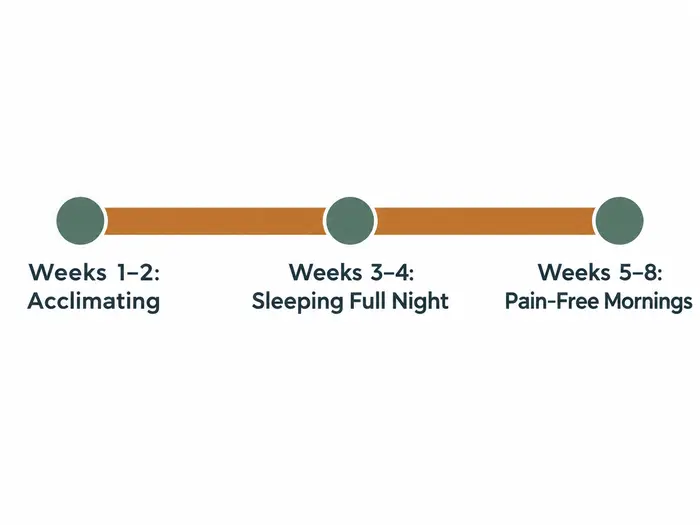
Most people notice a difference around Week 3. The guarantee covers 60 nights.
Week 1: Break-In
The first few nights feel strange — you're sleeping with something new on your foot.
Start at 2 hours, build up from there. By night 4 or 5, most people stop noticing it.
And some mornings, the stiffness already eases. You're not healed. But you're started.
"Night one I lasted 90 minutes. Night four I woke up with it still on." — Linda M., 61
Weeks 2–4: The First Surprise
By Week 2, most people wear it the full night.
And then one morning — usually around Week 3 — something small happens.
You stand up. You take three or four steps. And you stop. Not because it hurts.
Because it didn't.
That's the moment. Not pain-free. Not healed. Less. The stab loses its edge.
The hobble shortens to a few steps instead of ten minutes.
You catch yourself halfway to the bathroom walking, not shuffling.
And something shifts — you stop bracing before you stand.
You stop thinking of yourself as the person with bad feet.
"By week three, the morning hobble to the loo is almost gone." — Sarah P., 56, Practice Nurse
Weeks 5–12: Mornings Without the Math
This is the part people don't expect. It's not less pain — it's less planning.
You stop doing the math before you stand up. You stop bracing for the alarm.
One morning, you walk to the kitchen, pour your coffee, and realize — your feet never crossed your mind.
"My foot has felt NORMAL each morning." That's the word people use most.
Not better. Normal.
That's not a small thing.
That's the morning you used to have — before plantar fasciitis made you plan every step.
You're not "managing pain." You're a person who wakes up and walks.
The 2023 APTA guideline recommends 1 to 3 months of nightly use.
After that, some people taper. Others keep going. You'll know.
Everyone is different. The 2023 APTA guideline recommends night splinting for morning heel pain.
It calls it one part of a broader plan — not a standalone fix. The research is promising. The clinical logic is sound.
Results vary. That's why we built the guarantee around 60 nights — long enough for consistent use to show.
Long enough for you to know for yourself.
You didn't choose this pain. But the person you were before it.
The one who walked barefoot through the house. Who stood up without thinking. Who didn't plan every step before she took it.
She's not gone.
Somewhere along the way, you started thinking of yourself as the person with bad feet.
The one who takes the lift instead of the stairs. The one who says "I need a minute" before standing up at dinner.
The one who scans a room for the nearest chair.
That's not who you are. That's what pain taught you to expect.
Picture a morning three weeks from now. The alarm goes off. You put both feet on the floor.
And you walk — to the kitchen, to the door, down the hall. No bracing. No counting steps.
No shuffling sideways because the straight path hurts more.
You pour your coffee standing up. You let the dog out.
And at some point that day, you realize — you haven't planned a single step. You moved. Like you used to.
That's not a different person.
That's the one you've been underneath this pain the whole time.
Waiting for a morning that doesn't start with a wince.

"I walked to the kitchen this morning without stopping once."
"After eight months of that stabbing first-step pain, I'd tried everything.
"Stretches, orthotics, frozen water bottles.
"My physio suggested a night splint, but the first one I ordered was so bulky I lasted two nights.
"This one's different. Light, breathable, and the break-in schedule works.
"By week three, my mornings were better."
— Janet W., 59 · Retired Teacher · Vancouver, BC · Verified purchaser
Open the Box Tonight. Start Tomorrow Different.
Your complete morning kit — splint, break-in schedule, and bedside guide. Open the box and start tonight.
DorsalFlex Adjustable Night Splint
The splint you'll actually wear all night.
Slim dorsal bar, open heel, padded adjustable straps.
Fits sizes 5–13. Start tonight.
Bedside First-Steps Routine Guide
Your first 10 steps set the tone for the whole morning.
This card sits on your nightstand and walks you through the 60-second routine that makes those steps easier.
Remove splint, ankle pumps, towel stretch, then stand.
2-Week Break-In Schedule
The reason most splints end up in the closet: people try to wear them all night on day one.
This schedule starts you at 2 hours and builds to full night by day 10.
So you never hit the wall that made you quit the last one.
Ready to Fix Your Mornings?
60 nights to try it. Free shipping both ways. No subscription.
The same splint sells for $80–$120 through PT clinics. We sell direct — no distributor, no clinic markup. That's why.
Comfort Set adds: silicone toe separators + fascia massage roller + 2-week recovery guide. If you wake up mid-sleep from arch cramping or secondary foot tension as the fascia loosens, the toe separators and roller address that directly.
Wake Up Without the Hobble →60-Night Morning Walk Guarantee · Ships same day on orders by 2 PM EST
Start tonight — most people notice a difference in their first 10 steps within two weeks.

"Third night splint. First one still on my foot at sunrise."
"The Strassburg Sock rolled off by midnight.
"The Amazon boot gave me numb toes and sweaty sheets.
"I'd written off the whole category.
"But this one sits on top of your foot — no plastic shell underneath, no heat trap.
"I wore it the full night by day four.
"Three weeks in, the morning stab is duller and the hobble is maybe three steps instead of the whole hallway."
— Barbara K., 63 · Retired Teacher · Portland, OR · Verified purchaser

"First morning in months where my feet didn't cross my mind."
"I'm on my feet all day at work. And the morning pain was making everything harder.
"The walk from the car park, standing at assemblies, playground duty.
"I was sceptical about another splint after the boot I binned after a week.
"But this one's so low-profile I forget it's on.
"Four weeks in and my mornings are a different story."
— Michelle T., 52 · School Administrator · Melbourne, AU · Verified purchaser
What Almost Stopped Our Customers from Ordering
I’ve tried night splints before and they didn’t work. Why would this be different?
If your previous splint was a boot you ripped off at midnight, it didn’t fail because overnight stretching doesn’t work.
It failed because you couldn’t wear it long enough to get results.
The clinical guidelines still recommend night splints for 1–3 months.
The issue was wear time, not the concept.
The DorsalFlex is a dorsal splint — the support structure sits on top of your foot, not underneath.
That’s the design difference that lets people wear it through the night.
Both feet hurt. Do I need two?
About one-third of plantar fasciitis cases affect both feet. The 2-Pack at $109 ($54.50 each) is made for this.
Some people start on the worse foot and add the second once they’ve adjusted. Either approach works.
How long until I feel a difference?
Most people notice something in the first two weeks. A duller stab. A shorter hobble.
A morning where you forget to brace before standing.
The 2023 APTA guideline recommends 1 to 3 months of nightly use.
That’s why the guarantee runs 60 nights — enough time for consistent wear to show.
Can I use my HSA or FSA to pay for this?
Night splints qualify for HSA/FSA as orthopedic devices.
We provide an itemized receipt with the product description your plan needs.
Check with your benefits provider to confirm. Most approve it without a letter of medical necessity.
Can I wear socks with it?
Yes. The open-heel, open-toe design means socks fit naturally underneath.
Many customers wear a thin cotton sock for extra comfort in the first week.
The padded straps sit over the sock without slipping.

"My only regret is not trying a dorsal splint sooner."
"I spent over $500 on custom orthotics and two different boots before finding this.
"The difference is the design — nothing under your foot, nothing squeezing your toes.
"I can sleep on my side, get up for the bathroom, and it's still on in the morning.
"Wish I'd known dorsal splints existed a year ago."
— Helen D., 58 · Community Nurse · Wellington, NZ · Verified purchaser
Ships internationally to New Zealand and 30+ countries. Standard delivery 7–14 business days.
Free return shipping included in the 60-Night Morning Walk Guarantee.
The Mornings Don't Wait
Picture tomorrow morning — a different one.
Your alarm goes off. You swing your legs over the edge of the bed.
Your feet touch the cool floor, and you stand up. No hobbling. No gripping the nightstand.
No stabbing pain through your heel. You walk to the kitchen. Pour your coffee.
And somewhere between the first sip and the second, you realize your feet never crossed your mind.
But that’s not tomorrow yet.
Tomorrow, your alarm goes off and you already know what’s coming. That sharp, familiar pain through your heel.
The hobble to the bathroom. Five minutes of stretching before you can walk normally in your own home.
That’s tonight’s contribution. While you sleep, your foot relaxes into a pointed-down position.
For 6 to 8 hours, the tissue along your sole contracts.
Tomorrow morning, your full bodyweight snaps that contracted tissue open — cold, under load.
That will happen tonight whether you order the DorsalFlex or not. It happened last night.
It will happen tomorrow night. And the night after that.
Why does it cost less than one copay?
The same dorsal splint sells for $80–$120 through PT clinics.
We cut out the distributor and the clinic markup. That's why yours starts at $59.
It comes with 60 nights to prove it or return it free.
The question is how many more mornings you want to start that way.
Free shipping both ways · 60-Night Morning Walk Guarantee · We cover return shipping
Click below → pick your size → secure checkout → we ship tomorrow in a plain box → try it for 60 nights risk-free.
✓ In stock now. Order by 2 PM EST and start tomorrow night.
Small-batch production — current run ships now. Next run is 2–3 weeks out.
The DorsalFlex holds your foot at the angle your tissue needs to loosen overnight.
No rigid boot shell. No 2 AM wake-ups. Open heel. Sleep in any position. Most people adjust within 3–5 nights.
Free shipping. Wear it every night for 60 nights. If your first 10 steps don't feel easier, you get a full refund.
No forms. No hoops.
One splint. 60 nights. Either you walk easier, or you pay nothing.
Still Not Sure? That's Exactly Where Linda Was.
"I'd already bought three different splints off Amazon.
The big boot, the sock thing, and a strap that dug into my ankle.
"They all ended up in my closet. I almost didn't try this one.
"But the 60-night guarantee meant I could send it back.
"It's been 11 weeks and I haven't even thought about sending it back."
— Linda M., 61 · Verified Buyer
A note from Dr. Hayes —
If you've read this far, you've tried a night splint before. Ripped it off by 2 AM.
Put it in the closet and told yourself you'd tried everything.
I've treated hundreds of people who said the same thing — and most of them were right.
The device failed them, not the other way around.
This trial is 60 nights for one reason: I know you need to live in it, not try it once.
And if after 60 nights your mornings aren't better, you send it back free. No guilt.
No hoops. You've earned the right to be skeptical.
I'm asking you to be skeptical for one more trial — but this time with a real refund behind it.
The guarantee is simple: Wear it every night for up to 60 nights.
If your mornings don't improve, return it for a full refund — we even cover return shipping.
No forms. No hoops. No restocking fee.
Free shipping both ways · 60-Night Morning Walk Guarantee
Click below → pick your size → secure checkout → we ship tomorrow in a plain box → try it for 60 nights risk-free.